人民的名义
Grassroots official’s 30-year fight against desertification in North China_我的网站

A | Late Major Mohit Sharma's parents have approached the Delhi High Court and sought an immediate stay on the release of Ranveer Singh and Aditya Dhar's Dhurandhar. The family alleged that the upcoming film draws heavy inspiration from the life of the Ashoka Chakra and Sena Medal awardee, without the permission of the family or the Indian Army.
They alleged that various elements shown in the trailer and promotional videos seem to replicate major events from Sharma's military career, including classified counter-terrorism operations and undercover missions.In its plea, the family members stated that a martyr is not a commercial commodity and his life cannot be recreated for profit, 'without truth, dignity and due permission.'
Besides violating the family's right to privacy, the film also portrays sensitive military strategies, claimed the family. They said that infiltration methods and operational details of the security forces have been revealed in Dhurandhar and argued that it can cause National Security concerns. Sharma's family also alleged that the makers did this without obtaining clearance or approving the script from the Indian Army's Additional Directorate General of Public Information (ADGPI). ADGPI is responsible for seeing how the Indian Army is represented in films and media.
Citing these reasons, the family requested the Delhi High Court to halt the release of Ranveer Singh's film until they are allowed to watch it privately.
Meanwhile, filmmaker Aditya Dhar has already clarified that Dhurandhar is not based on Major Mohit Sharma. Ever since the trailer released, speculations had been going around its real-life connections, as the film is reportedly inspired by actual events. One such rumoured connection suggested that Ranveer Singh's character is linked to Major Mohit Sharma, who reportedly operated undercover as Iftikhar Bhatt and infiltrated Hizbul Mujahideen in the early 2000s.
In response to a question from Madhur Sharma, Mohit's brother, who had tagged him to confirm, Aditya wrote, "Hi, sir - our film Dhurandhar is not based on the life of brave heart Major Mohit Sharma AC(P) SM. This is an official clarification. I assure you, if we do make a biopic on Mohit sir in the future, we will do it with full consent and in complete consultation with the family, and in a way that truly honours his sacrifice for the nation and the legacy it has left for all of us."
Major Mohit was posthumously honoured with the Ashoka Chakra, India's highest peacetime military decoration, for his ultimate sacrifice in 2009 during a fight with terrorists in the Kupwara sector of Jammu and Kashmir.
Dhurandhar will be released theatrically on December 5.
Also Read: Aditya Dhar Says Dhurandhar Has No Link to Major Mohit Sharma’s Life。
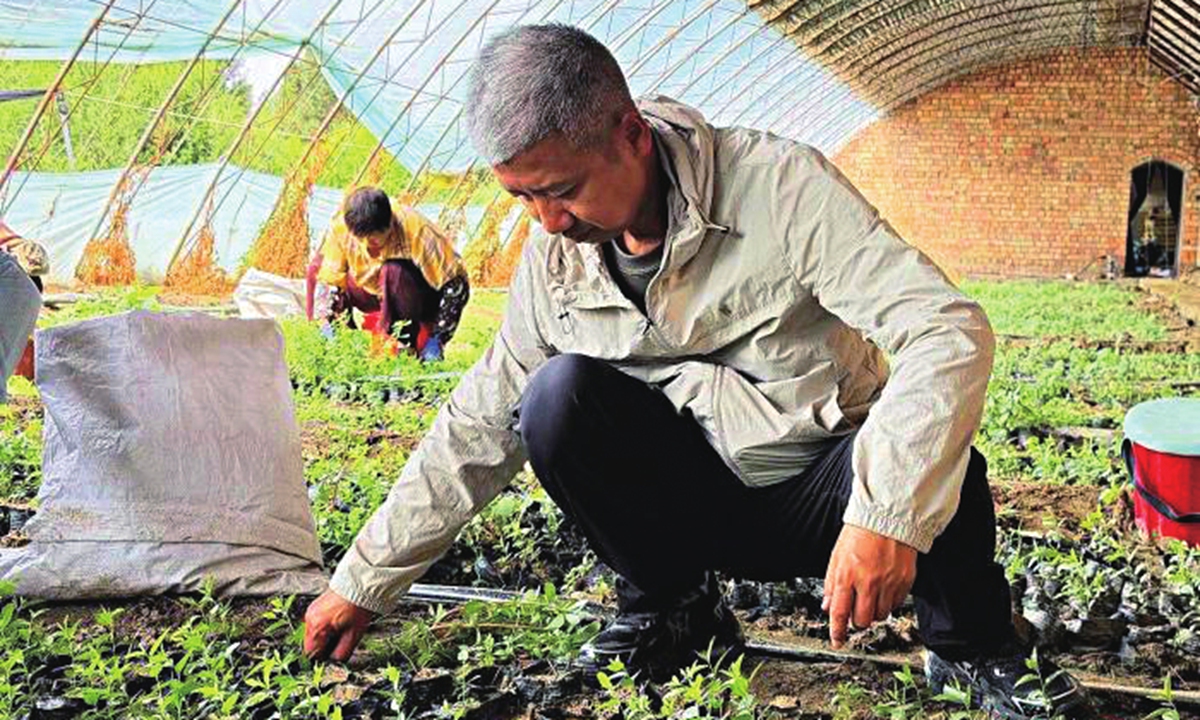
Wensuyalatu checks the growth of sour jujube seedlings. Photos: Chinanews.comAcross the vast desert landscape of the Urad Rear Banner in North China's Inner Mongolia Autonomous Region, one grassroots official has spent more than three decades turning barren sands into patches of green.
Ecological restorationFor over 30 years, Wensuyalatu, a member of the leadership group of the Urad Rear Banner forestry and grassland bureau, has made the Gobi Desert his workplace, dedicating his life to combating desertification, advancing ecological restoration through technological innovation, and helping local herders increase their incomes, according to the local bureau's official WeChat account.
Located on the edge of the desert in Bayannur's Urad Rear Banner, it is a key area in China's Three-North Shelterbelt Forest Program, a major ecological project aimed at strengthening the country's northern ecological security barrier.
However, early afforestation efforts in the desert were far from easy at the start.
The project covers 103,800
mu (about 6,920 hectares), including comprehensive treatment of 24,500
mu of desertified land, ecological restoration of 4,100
mu of non-desertified land, and 75,200
mu of enclosed grassland restoration. The project also includes the construction of 11 small-scale water conservation facilities, all of which required strict standards and extensive coordination.
The project also includes the construction of 11 small-scale water conservation facilities, all of which required strict standards and extensive coordination.
In 1991, Wensuyalatu, then in his early 20s, chose to devote himself to forestry and grassland conservation in the Urad Rear Banner. Since then, he has remained on the front lines of desertification control, witnessing the region's harshest environmental challenges and working to find solutions adapted to the fragile desert ecosystem.
In the early years, afforestation in the Gobi Desert was an extremely difficult task. The most critical planting season in spring often coincided with the strongest sandstorms of the year. Every year during the key afforestation period, Wensuyalatu would stay deep in the desert, guiding workers on planting techniques and management practices, while carefully overseeing every detail of the ecological restoration projects.
"Every spring, the wind and blown sand were so strong that it was hard to keep your eyes open. The sand hit your face like needles. During the day, we followed workers to dig holes and plant trees, and at night we stayed in temporary shelters to organize data and review the day's work. That was the normal routine for desertification fighters," Wensuyalatu recalled.
The road to restoring the desert was far from easy. Years of drought, low survival rates of seedlings, and skepticism from some local residents created major obstacles.
"At the beginning, it was really difficult. The climate was extremely dry, and many seedlings died after being planted. Some herders did not understand or support the work. They believed deserts were naturally barren and that no amount of effort could make trees grow there," Wensuyalatu said.
To change these perceptions, Wensuyalatu brought local residents to see firsthand the damage caused by desert expansion. Through visible results and long-term communication, he gradually won the understanding and support of the community.
Facing the ecological challenges of the Urad Rear Banner, Wensuyalatu began exploring new approaches beyond traditional restoration methods.
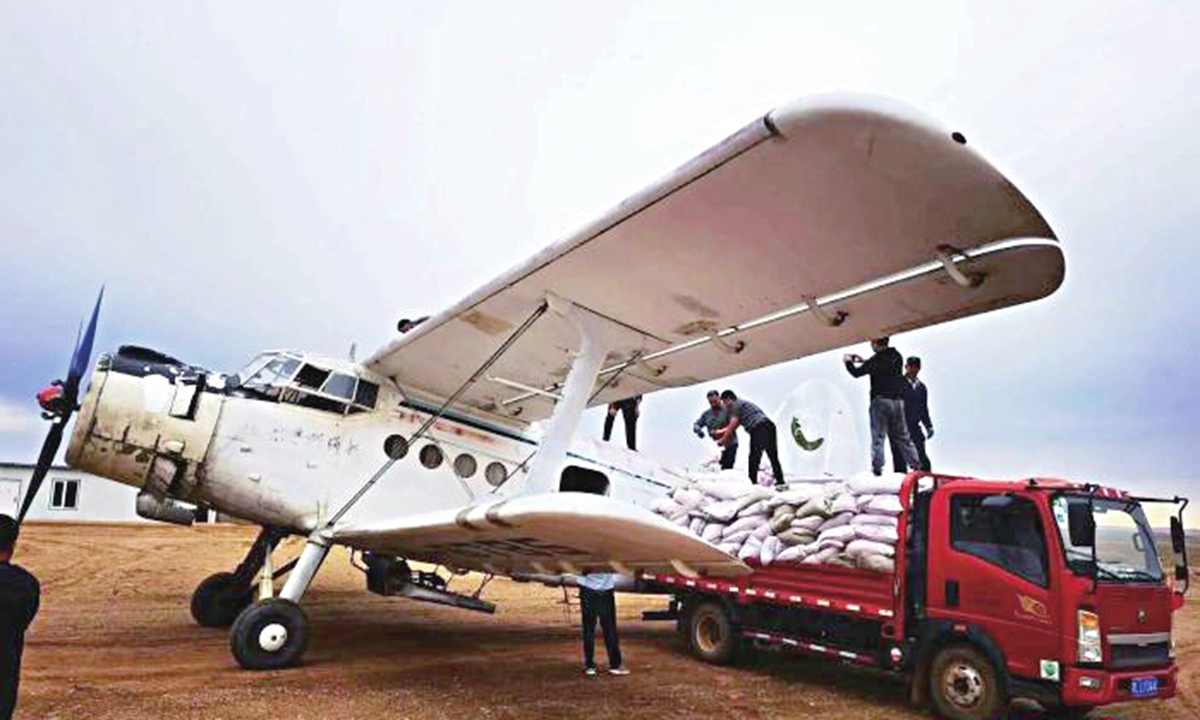
Staff members get ready to carry out aerial seeding operations.
Aerial seedingSince 2004, he has led efforts to tackle desert restoration challenges by introducing large-scale aerial seeding projects, creating a breakthrough approach for restoring degraded desert ecosystems in the region.
"Compared with traditional methods, aerial seeding is more efficient and can cover wider areas. Based on local climate and soil conditions, we select suitable desert plant seeds and precisely control the seeding height, density and timing to improve survival rates as much as possible and accelerate desert recovery," Wensuyalatu explained.
After years of effort, the aerial seeding projects under Wensuyalatu's leadership have restored more than 800,000
mu of desert land, with an effective restoration rate of 62.2 percent.
He also developed an integrated management approach combining "protection, management, retreat, restoration and publicity," establishing a mixed vegetation system of trees, shrubs and grass to curb desert expansion and reduce sandstorms at their source.
Beyond restoring greenery, Wensuyalatu has also focused on strengthening scientific research and protecting native desert species.
Starting in 2010, he devoted himself to the artificial cultivation of endangered native desert plants. After more than a decade of repeated experiments, he successfully developed cultivation techniques for rare species such as the endangered evergreen broadleaf shrub
Ammopiptanthus mongolicus, Mongolian almond and drought-resistant elm.
Under his leadership, his team cultivated 6.5 million seedlings and completed more than 4,000
mu of high-quality afforestation projects, with seedling survival rates consistently exceeding 80 percent.
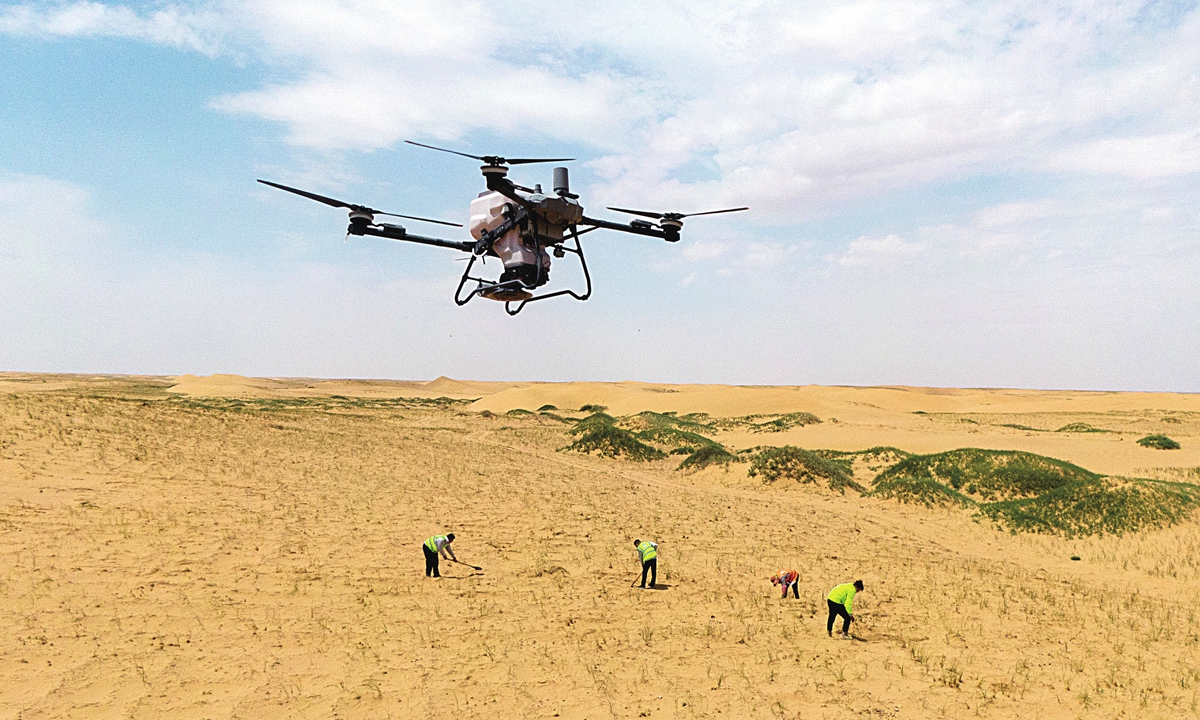
Engineering personnel operate drones to conduct aerial seeding as part of afforestation efforts in the Badain Jaran Desert in North China on June 17, 2025. Photo: VCGHis achievements filled a technological gap in large-scale cultivation of native desert plants and earned him second prize in the 2017 Inner Mongolia Autonomous Region Harvest Award.
For Wensuyalatu, desert restoration is not only about creating ecological benefits, but also about improving people's livelihoods.
He has long promoted the idea that "trees should bring both ecological value and economic value." By leveraging local desert resources, he helped establish a 10,000-
mu industrial base for desert plants and cistanche - a medicinal plant often grown in desert environments - across four key local villages, integrating ecological restoration with specialty desert industries.
"In the past, people thought desertification control was simply about planting trees - it took a lot of efforts but brought little income. Now things are different. By planting trees and developing industries such as cistanche cultivation, desert land can generate real wealth," a local herder said.
To ensure that local communities benefit from ecological development, Wensuyalatu introduced enterprises, supported family forest farms and professional cooperatives, and promoted large-scale, market-oriented operations.
The once barren desert has gradually become a "green treasure chest" for local herders, achieving a win-win outcome: greener landscapes, improved ecosystems, stronger businesses and higher incomes.
"Desertification control is not just an ecological project, but also a project that benefits people," Wensuyalatu said.
"Only when communities gain real benefits from protecting nature will they actively participate in ecological conservation. That is the key to making restoration efforts sustainable and achieving the vision that lucid waters and lush mountains are invaluable assets," Wensuyalatu said.
Global Times
。
Current article:http://ctx5.zhenzongtingrangunhongqiusao.shop/wue8as/20260826/8721998.html
Published on:17:00:30

 【フィギュア】女子金のアリサ・リュウ〝体脂肪率〟批判まで…中国から誹謗中傷の被害=海外報道
 大乐透26076期开4注一等奖
 China's homegrown C919 aircraft completes 1st int'l commercial flight, lands in Mongolian capital
 马雷斯卡:内托在右路表现更好,但我们还有马杜埃凯和桑乔
 迅雷Mac 3.3.0.3874正式发布:解决客户端异常退出问题
 前7个月山东接待国内游客5.3亿人次,国庆假期凤凰传奇、周杰伦将来鲁开唱
查看所有0条评论>>